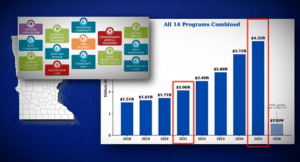
Last year, Minnesota paid $4.32 billion in Medicaid reimbursements to the 14 programs now identified as being a high risk for fraud — more than double what it paid in 2021.
As more reimbursements have been finalized, a KARE 11 data practices request reveals the total since 2018 is $20 billion — even more than the astonishing $18 billion former acting U.S. Attorney Joe Thompson revealed in December.
More than half of the $20 billion in reimbursements went through Personal Care Assistance or PCA — now called Community First Services and Supports, where providers help the disabled and elderly with day-to-day tasks. Minnesota’s Attorney General has charged many suspects with PCA Fraud.
At the end of his tenure, Thompson began charging suspects with defrauding the Housing Stabilization program — 18 people so far. Now completely shut down by Governor Tim Walz, this new data reveals the program paid a total of $338.9 million.
Steep year-to-year increases happened within the $508.6 million Integrated Community Supports program and the $1.29 billion Autism Services — perhaps now the most highly scrutinized program within the Minnesota Department of Human Services (DHS).
The lesser-known program “Night Supervision” grew from $4.9 million in 2018 to $68.6 million in 2021, and all the way to $305.5 million in 2025.
Here are the totals for each program:
Minnesota Medicaid Reimbursements for 14 High-Risk Programs: $20.83 billion
2018: $1.51 billion
2019: $1.61 billion
2020: $1.71 billion
2021: $2.06 billion
2022: $2.49 billion
2023: $2.89 billion
2024: $3.72 billion
2025: $4.32 billion
2026: $529.9 million (partial, Jan 1–Mar 17)
EIDBI (Autism Services) Total: $1.29 billion
2018: $6.1 million
2019: $20.5 million
2020: $38.2 million
2021: $83.1 million
2022: $125.1 million
2023: $189.3 million
2024: $341.7 million
2025: $443.3 million
2026: $45.4 million
Night Supervision Total: $980.0 million
2018: $4.9 million
2019: $12.7 million
2020: $32.8 million
2021: $68.6 million
2022: $110.8 million
2023: $165.6 million
2024: $233.3 million
2025: $305.5 million
2026: $45.7 million
Integrated Community Supports Total: $508.6 million
2021: $4.6 million
2022: $26.1 million
2023: $88.1 million
2024: $174.9 million
2025: $193.6 million
2026: $21.3 million
Housing Stabilization Services Total: $338.9 million
2020: $3.3 million
2021: $28.2 million
2022: $46.5 million
2023: $79.6 million
2024: $108.8 million
2025: $72.4 million
2026: $0
Peer Recovery Total: $97.7 million
2018: $29.6K
2019: $514.1K
2020: $1.4 million
2021: $3.6 million
2022: $12.3 million
2023: $32.0 million
2024: $25.4 million
2025: $20.5 million
2026: $2.0 million
Individualized Home Supports Total: $3.19 billion
2018: $124.1 million
2019: $146.1 million
2020: $192.9 million
2021: $317.9 million
2022: $429.1 million
2023: $503.7 million
2024: $620.6 million
2025: $749.0 million
2026: $102.4 million
ARMHS Total: $843.8 million
2018: $62.8 million
2019: $65.5 million
2020: $69.4 million
2021: $77.3 million
2022: $96.6 million
2023: $118.7 million
2024: $144.6 million
2025: $190.0 million
2026: $19.1 million
PCA and CFSS Total: $10.73 billion
2018: $1.03 billion
2019: $1.06 billion
2020: $1.12 billion
2021: $1.17 billion
2022: $1.30 billion
2023: $1.33 billion
2024: $1.62 billion
2025: $1.87 billion
2026: $244.4 million
Non-Emergency Medical Transport Total: $1.03 billion
2018: $123.2 million
2019: $127.4 million
2020: $96.6 million
2021: $111.1 million
2022: $120.7 million
2023: $139.0 million
2024: $155.7 million
2025: $143.2 million
2026: $14.1 million
Adult Day Services Total: $767.1 million
2018: $73.8 million
2019: $84.7 million
2020: $52.0 million
2021: $76.6 million
2022: $90.6 million
2023: $101.0 million
2024: $133.1 million
2025: $140.3 million
2026: $15.1 million
IRTS Total: $693.7 million
2018: $51.1 million
2019: $55.5 million
2020: $61.0 million
2021: $73.5 million
2022: $85.7 million
2023: $96.8 million
2024: $115.9 million
2025: $138.0 million
2026: $16.3 million
Assertive Community Treatment Total: $358.1 million
2018: $38.6 million
2019: $42.8 million
2020: $45.1 million
2021: $44.5 million
2022: $43.1 million
2023: $43.5 million
2024: $47.8 million
2025: $49.0 million
2026: $3.8 million
Adult Companion Services Total: $6.4 million
2018: $620.2K
2019: $600.9K
2020: $351.3K
2021: $356.7K
2022: $467.9K
2023: $416.8K
2024: $1.5 million
2025: $1.9 million
2026: $139.7K
Recuperative Care Total: $1.6 million
2025: $1.3 million
2026: $358.5K
DHS released the following statement:
Significant growth in program spending, especially new programs, is not in and of itself an indicator of fraud. For example, night supervision was one of several disability services that had significant rate increases through inflationary adjustments and other legislative changes. This included two increases in 2024 (15.39% and 2%). Legislators approved the same increases for Individualized Home Supports and Integrated Community Supports.
Still, monitoring growth in spending is one aspect of oversight. Across the country, increasingly sophisticated fraud and abuse schemes threaten health care systems. Bad actors are adapting faster than ever – exposing gaps in aging technology, disconnected data and manual processes that were built for a different era. That’s why we’re moving aggressively to update and strengthen data analytics in new ways to fight fraud and become the best state in the country for Medicaid program integrity. Program integrity and protecting taxpayer dollars are essential pillars of the department’s mission to serve the people of Minnesota.
Source: KARE TV