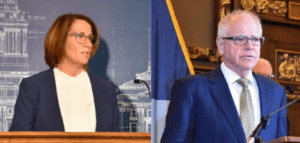
DFL Senate Majority Leader Erin Murphy says Gov. Tim Walz could have been more aggressive in using his executive authority to stop or reduce fraud in state social service programs, a rare admission from a prominent political figure in the governor’s own party.
Murphy, the top-ranking figure in the state Senate, made the admission during an interview with Rochester Post Bulletin reporters last week.
Rochester Tornado – Century Hills
At one point in the interview, Murphy was asked whether Walz could have used his authority to stop or contain fraud earlier than he did. Murphy said, “Yes.”
Murphy later noted that the actions Walz has taken since the fraud issue has come to dominate the political spotlight include creating a new fraud division at the Bureau of Criminal Apprehension, empowering the Department of Human Services inspector general, and increasing coordination across agencies to stop taxpayer dollars going to bad actors.
“Could he have done something sooner? Yes,” Murphy said. “I don’t think there’s a big surprise. There shouldn’t be. I’ve done a lot of work with the governor and have a deep respect for him. He has said himself that he is going to use this last term to tackle the issue, because he understands he has responsibility there. And I really appreciate that. He’s a good leader.”
Murphy also noted that fraud in state human services has been a problem that has existed for years over past governorships and legislatures. She cited a recently released report written by Tim O’Malley, called the “Roadmap to Program Integrity and Fraud Prevention,” which described vulnerabilities in social service programs having existed for decades.
“Everybody’s got a hand in this. We all have a hand in fixing this,” Murphy said, adding, “But I think to your question, the Walz administration could have been more decisive.”
Republicans at the state and federal levels have long hammered Walz for failing to stem fraud in the state, which came to the fore in 2022 during the Feeding Our Future scandal. An estimated $250 million in taxpayer dollars was stolen from a program meant to feed children during the COVID pandemic. But Democrats have been largely silent on whether Walz could have done more to combat fraud.
Rep. Greg Davids, a Republican from Preston, credited Murphy with making a “very honest statement.” He said investigations at the congressional and state level have revealed that Walz “knew about a lot of this stuff and did nothing about it. And that, to me, is a real problem.”
Davids believes Walz demonstrated his authority to move aggressively against suspected fraud when his administration ended the state’s Housing Stabilization Services program last year after allegations of financial impropriety came to light.
His move was prompted by revelations that the program had exploded in growth. Created by the Legislature in 2017, analysts expected the cost of the housing programs to be $2.6 million, but by 2024, the cost had soared to $107 million.
By that time, concerns about fraud were a statewide preoccupation and a DFL political liability, later contributing to Walz’s decision not to seek a third term as governor.
“He stopped the payment, shut the program down,” Davids said, referring to how Walz used executive authority to stop fraud.
Walz previously said he just gained that authority in June 2025.
Confusion has often reigned over the power Walz possessed and could have used to direct the stoppage of the payments sooner. In response to a query from the PB about Murphy’s comment that Walz could have acted sooner, the Walz administration referred to a Dec. 15, 2025, opinion piece authored by Walz titled “Governor Walz: We take fraud seriously. Here’s what we’re doing to stop it.”
“Over the last three years, we have made systematic changes to state government,” Walz wrote. “Detecting fraud is a resource intensive and time consuming — especially when it comes to the federal Medicaid programs that have a complex interplay between private insurance companies and federal, state and county governments. Is it impossible? No. We have made significant progress. We have much more to do.”
Toward the start of the current legislative session, Walz revealed his anti-fraud package. One high-profile and bipartisan anti-fraud proposal for lawmakers this session is the bill to create a statewide Office of Inspector General, SF856. It passed the Senate 60-7 last session, and Walz has said he’d sign it. The measure stalled in the House earlier this session but recently advanced.
Estimates of total fraud in state programs have ranged wildly, from hundreds of millions of dollars to as much as $9 billion. Federal prosecutors have obtained more than 60 convictions of individuals, a majority of whom are of Somali descent, stemming from fraud in social service programs in the state that receive Medicaid funding.
Last month, Walz and state Attorney General Keith Ellison defended their efforts to combat fraud before a U.S. House committee, where GOP members accused both of them of putting politics ahead of rooting out abuse.
“You have not been good stewards of the taxpayer dollars,” said Republican James Comer of Kentucky, chair of the committee.
By that time, the state’s fraud scandals had been eclipsed by federal immigration enforcement efforts and the killing of two protesters by federal agents.
Walz told the committee he wanted to work with the federal government to help with fraud investigations, but the immigration surge was making that difficult.
Source: Rochester Post-Bulletin