It would run afoul of the First Amendment, among other issues.
By Annette Meeks
Guest contributor to the Minnesota Star Tribune
April 20, 2026
•••
What do progressives do when they run out of other people’s money to spend? You don’t have to look any further than Minnesota to find out: Recently Gov. Tim Walz proposed a first-of-the-nation “social media tax.” Yes, they invent new methods of taxation that exist nowhere else in the U.S.
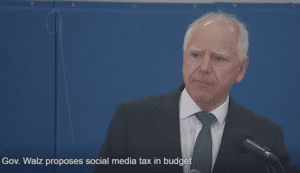
Walz’s budget proposal would impose a per-user excise tax on very popular social media platforms such as Facebook, Instagram or X, with the largest companies paying a massive monthly fee plus a surcharge for every Minnesota user. By targeting media platforms based on how many people use them, the state is effectively taxing the reach of speech itself.
The most interesting thing about this proposal is that in 1983, the U.S. Supreme Court struck down a Minnesota state tax on newspapers that kicked in only after a publication reached a certain size. In Minneapolis Star & Tribune Co. v. Minnesota Commissioner of Revenue, the 8-1 ruling by the court was unambiguous: The government cannot single out media companies for punitive taxes based on the size of their audience.
More than four decades later, Walz is poised to do exactly that, attempting to introduce a first-of-its-kind “social media tax” that is nothing more than a digital toll on the town square. While the governor frames this as a forward-thinking way to fund a response to “AI displacement” in the workforce, the proposal is an unconstitutional cash grab that threatens Minnesota’s small businesses and violates the fundamental principles of free speech.
The budget proposal would impose a per-user excise tax on social media platforms, with the largest companies paying a massive monthly fee plus a surcharge for every Minnesota user. By targeting platforms based on how many people use them, the state is effectively taxing the reach of speech itself, precisely what the Supreme Court prohibited in the Star Tribune case.
Social media is where Minnesotans debate politics, organize community events and share their lives. A levy calibrated to audience size doesn’t tax a business activity in any neutral sense; it taxes popularity. It punishes platforms for being too useful to too many people. The First Amendment does not just protect the right to speak; it protects the mediums through which we communicate. Singling out digital platforms for a special tax that doesn’t apply to traditional media, newspapers, broadcast television or radio is blatant speaker-based discrimination. Minnesota’s own Supreme Court precedent makes this clear.
Proponents suggest this tax extracts “fair share” payments from tech giants to solve future labor issues. Basic economics tells a different story. Taxes on advertising are rarely absorbed by the company; they are passed directly to customers: Minnesota’s small-business owners who advertise on these popular web platforms.
In the modern economy, digital advertising is the lifeblood of the “Main Street” entrepreneur. Whether it’s a local craft brewery in Duluth, a boutique shop in Edina or a family-owned restaurant in Walker, businesses rely on the precision of social media to reach their neighbors. Increasing the cost of digital advertising acts as a stealth tax on Minnesota businesses and entrepreneurship. At a time when many businesses are already struggling with higher costs, the last thing they need is a new state-imposed digital tax.
Beyond the First Amendment violation, the Walz proposed tax runs headlong into the federal Permanent Internet Tax Freedom Act (PITFA). Back in the day when I was fortunate to work in the U.S. House, forward-thinking members of Congress passed a temporary law, which was made permanent in 2015, that specifically prevents states from imposing discriminatory taxes on electronic commerce. Walz’s proposal taxes Facebook or X for connecting Minnesotans online while local newspapers that host community forums face no equivalent burden for doing the same thing. This is exactly the discrimination PITFA was designed to prohibit.
It’s easy to see why the Walz administration is seeking more money to spend: After blowing through the $18 billion surplus in 2023 plus the unthinkable increase in state spending, they realize that Minnesota taxpayers are tapped out. Yet the far left’s thirst for more state spending remains undiminished. So, the Walz administration, like 20th-century bank robber Willie Sutton, are going “where the money is” — highly profitable and popular social media companies.
Minnesota has an opportunity to learn from its own history. Rather than repeat the constitutional missteps of the past, policymakers should reject this budget proposal and learn to live within our means without raising any additional taxes. The path forward is clear, and it doesn’t require litigating a case Minnesota has already lost.
Annette Meeks is CEO of the Freedom Foundation of Minnesota.